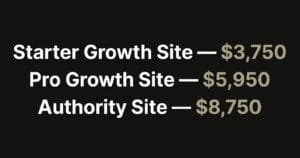
I spent years on the agency side of this business in addition to being solo. Not adjacent to it — inside it, on the teams that scoped the work, staffed the projects, and produced the proposals clients eventually signed. That’s where the number on this site’s pricing page comes from. Not a competitor analysis. Firsthand knowledge of how the other number gets built.
I want to walk through that, because “agencies charge more” isn’t the interesting part. The interesting part is why, structurally, and once you see the structure, you can actually judge whether it’s worth paying for on your specific project — instead of just assuming a bigger number means a better site.
What an agency quote is actually pricing
A website quote from a solo operator is pricing hours of build work. A quote from an agency structured the way most are is pricing something different: a team.
In my experience, a typical web project at an agency built this way has a coordinator keeping the project on schedule, an account manager who owns the client relationship, and often a project manager on top of that handling internal logistics. That’s before any of the people actually doing the work touch it. Layered on top: a design lead reviewing the visual direction, a copywriter or content strategist reviewing messaging, sometimes a separate strategist reviewing the whole approach before it goes to the client at all.
Every one of those people is a real expert doing real work. This isn’t a story about padding a bill with people who don’t contribute anything — that would be a much easier, much less honest story to tell. It’s a story about what that structure is optimized for, and it’s not what most small business owners actually need.
What the structure is actually built to do
That staffing model exists to produce consistency and reduce risk across a lot of clients running at once, not to get one specific client’s project done fast. Every extra reviewer is a checkpoint that catches mistakes before they reach the client — and also a checkpoint that adds a review cycle, a round of revisions, a meeting to reconcile feedback from three departments who don’t always agree with each other.
There’s a real tradeoff buried in that, and it’s worth naming directly: the pursuit of getting something right can come at the direct expense of getting something out the door. For an enterprise client running a rebrand across forty markets, that tradeoff is probably worth making — the cost of a mistake at that scale is enormous, and slow-and-correct beats fast-and-flawed. For a plumbing company that needs a site live before the next storm season, it usually isn’t. The structure doesn’t know the difference. It applies the same review depth regardless of whether the stakes call for it.
The number that structure produces
Here’s the part that’s uncomfortable to say plainly, but worth saying: in my experience, web projects at agencies structured this way rarely go below roughly $40,000 without real risk of the agency losing money on the engagement. That’s not a markup decision someone makes in a sales meeting. It’s what the staffing model costs to run, spread across the hours a project like that actually takes once every layer of review is accounted for.
For some businesses, that number is genuinely proportionate to what they need — a large, complex site, a rebrand, a project where the review depth is buying something real. For a lot of small businesses, it isn’t a bad number because the work behind it isn’t real. It’s a mismatched number, because the actual problem they’re trying to solve doesn’t require that much structure to solve it.
If your current site is decent — not broken, not embarrassing, just not generating the calls it should — the highest-leverage move might not be a full rebuild at all. It might be putting that same budget into SEO, local SEO, or a paid campaign built around the site you already have. A full rebuild is the right answer to “my site doesn’t represent my business.” It’s often the wrong answer to “my site isn’t showing up” or “my site gets traffic but not calls” — those are frequently marketing problems, not construction problems, and no amount of new design fixes a marketing problem.
Why the solo model exists
Everything above is the direct explanation for why I don’t run an agency-shaped business. There’s no account manager on my projects because that layer only needs to exist when the person building the site isn’t the person you’re talking to — and here, they’re the same person. There’s no junior staff member learning the ropes on your project’s budget, because there’s no junior staff. There’s no internal review chain reconciling feedback from three departments, because there’s one person making the calls, which means there’s one person to hold accountable when something’s wrong, not a committee to diffuse it across.
That’s not a claim that solo is better in every case — it’s a direct answer to the specific costs described above. Less structure means less overhead, which means a lower number, and it also means fewer checkpoints catching a mistake before it reaches you. That’s the actual tradeoff, not a marketing tagline version of it.
What you give up with a solo operator
I’d rather say this directly than let the pitch above stand unchallenged: working with one person has real limits. I can’t run five enterprise-scale projects simultaneously. If I’m heads-down on a build, that’s where my attention is — there’s no second person to pick up a request while I’m occupied elsewhere. There’s no specialist copywriter or dedicated strategist bringing a different discipline’s eye to the work; whatever expertise I have is the expertise on the project, full stop.
For some projects, that’s a real constraint, not just a hypothetical one. A business running multiple concurrent workstreams, or one that genuinely needs deep specialist input across several disciplines at once, may be better served by the agency structure I just spent this whole post describing the cost of. The point isn’t that the agency model is wrong. It’s that it’s priced for a specific kind of need, and it’s worth knowing whether that’s actually your need before you pay for it.
What to ask instead
If you’re comparing a proposal against my published pricing and trying to understand the gap, here’s a more useful question than “what’s included”: how many people will actually touch this project, and how many of them are billing hours to learn the account rather than execute on it.
That question tends to surface the real cost structure faster than a features list does. It won’t tell you which model is right for your project — that depends on what you actually need, not on which number is smaller. But it’ll tell you what you’re actually paying for, which is the thing most proposals are built not to make obvious.