A cheap website that never earns trust is expensive. So is a beautiful custom site that takes six months to launch while calls keep going to the competitor. This small business website cost breakdown focuses on the number that matters: what you need to spend for a credible, lead-generating site without paying for agency theater.
For most service businesses, a professional website build falls somewhere between $1,500 and $15,000. That is a wide range because a website is not one product. A one-page site for a handyman and a multi-location HVAC site with service pages, booking tools, local SEO, and custom copy are different jobs.
The right budget depends on your business model, the quality of your existing materials, and how much work the provider is handling. Clear scope is what turns a website quote from a guess into a business decision.
Small business website cost breakdown by project type
A basic do-it-yourself website can cost $200 to $1,000 in first-year software, templates, domain registration, and add-ons. The cash outlay is low, but your time is not free. If you are learning a builder, writing every word, choosing images, and troubleshooting mobile layouts between jobs, the real cost climbs quickly.
A freelancer-built small business site commonly runs from $1,500 to $5,000. This range can be a strong fit when the scope is contained: a handful of pages, a clean visual direction, contact forms, and a straightforward launch. The question is not whether the freelancer is cheaper. It is whether they have a defined process for messaging, mobile conversion, revisions, and post-launch support.
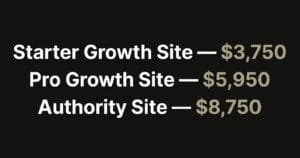
A focused, package-based website engagement often lands between $3,000 and $10,000. This is where many established local service businesses get the best value. You should expect strategy, custom design within a proven framework, page-level copy support, technical setup, conversion calls to action, and a site built to launch on a fixed timeline.
A custom agency project can range from $10,000 to $30,000 or more. That may be justified for businesses with complex integrations, multiple locations, a deep content strategy, a large team of stakeholders, or a major brand repositioning. It is overkill if you need a clear five-page site that gets more calls.
What actually drives the price
Page count is the most visible cost driver, but it is not the only one. Every page needs a purpose, structure, copy, design, mobile testing, and review. A home page, service page, about page, and contact page can be enough for a newer operator. An established plumbing company may need separate pages for drain cleaning, water heaters, repairs, installations, emergency service, financing, and each priority service area.
Copywriting also changes the price. A website cannot convert well if it says only “quality service” and “we do it all.” Strong copy answers the questions a prospect has before they call: What do you do? Where do you work? Why should they trust you? What happens next? Can they get help today? Writing that clearly takes discovery and judgment, not just filling a template with keywords.
Design complexity matters, but it should be kept in proportion. Custom illustrations, motion effects, unusual layouts, and elaborate animations take time. They can support a brand, but they do not automatically generate leads. For a local service business, fast load times, clear service information, visible phone numbers, proof of work, and an easy contact path usually matter more.
Functionality is another variable. A simple contact form costs far less than appointment scheduling, CRM routing, payment collection, customer portals, membership features, quote calculators, or custom integrations. These tools can be valuable, but each one should have a business reason behind it.
Finally, your readiness affects the budget. A provider can move faster when you have a logo, accurate service list, good job photos, service-area details, testimonials, and access to your domain. When those items are missing, someone must gather, create, or clarify them. That work belongs in the scope rather than appearing later as a surprise.
One-time costs versus ongoing website costs
A reliable budget separates the build from the operating expenses. The website build is the one-time project cost. Hosting, domain renewal, maintenance, software subscriptions, and marketing tools are ongoing costs.
Domain renewal is generally modest, often $15 to $30 per year. Quality hosting can range from roughly $150 to $600 per year for a typical small business site, depending on performance, support, backups, and security. Some platforms bundle hosting into a monthly plan, which can make the number easier to understand but does not make it disappear.
Maintenance usually ranges from $50 to $300 or more per month, depending on what is included. At the low end, that may cover updates, backups, security monitoring, and small technical fixes. At a higher level, it can include content changes, performance checks, reporting, and priority support. A business that rarely updates its site may need only a lean maintenance plan. A business running promotions, adding locations, or actively improving SEO may need more hands-on support.
You may also pay for call tracking, online booking, email marketing, review tools, premium forms, stock photography, or a CRM. Do not treat every subscription as mandatory. Start with tools that help you capture, respond to, and measure leads. Add the rest when there is a clear operational need.
Where small businesses waste website budget
The first waste is buying too much site. A 30-page website will not help if the business cannot keep the pages accurate or answer leads quickly. Build the pages that support your highest-value services and strongest search opportunities first. You can expand from a solid foundation.
The second is buying too little strategy. A low price can be appealing until you realize the provider has not asked about your service area, ideal jobs, sales process, differentiators, or goals. A site built without those inputs may look acceptable but say nothing useful.
The third is unclear scope. Watch for quotes that use broad promises such as “SEO included” without explaining what that means. Is it basic page setup, local keyword research, optimized service pages, Google Business Profile work, ongoing content, or all of the above? The same goes for revisions, content entry, training, and post-launch changes. If it is not written down, assume it needs clarification.
The fourth is treating launch as the finish line. A new website needs call tracking or at least form monitoring, a working contact flow, accurate business information, and someone responsible for responding to inquiries. A missed lead costs more than most hosting plans.
How to set a sensible budget
Start with the job the website must do. If you are a solo electrician who needs credibility and a steady path to phone calls, a polished starter site may be enough. If you run a growing restoration company with several high-value services, multiple crews, and active local search competition, investing in deeper service content and lead-routing features makes sense.
Then decide what you can provide and what you want handled. Supplying professional job photos and approved testimonials can reduce production time. Asking your web partner to shape the message, organize services, source imagery, and set up every technical detail may cost more upfront, but it can save weeks of stalled progress.
For many service businesses, the practical target is not the lowest quote. It is a fixed-scope project with defined deliverables, a realistic launch date, and an owner who can explain how the site will turn visitors into calls or form submissions. Browncoat Digital builds around that kind of clarity: enough structure to move quickly, enough customization to make the business credible, and no mystery about what comes next.
Questions to ask before signing a website proposal
Ask how many pages are included and what each page is intended to accomplish. Ask who writes the copy, provides photos, sets up the domain and hosting, and handles mobile testing. Ask what happens if the project needs a change outside the original scope.
You should also ask how leads are captured, where form submissions go, whether you will receive training, and what support is available after launch. If local search is a priority, ask what on-page SEO work is included and what it does not include. Straight answers are a good sign. Vague answers are a warning.
A good website budget should leave you with a working sales asset, not a design file and a new list of problems. Buy the scope your business can use now, make sure the foundation can grow, and put the remaining budget toward answering leads well once they arrive.