A website package is only a good deal if it helps a customer take the next step. For a plumber, that may mean a tap-to-call button when a basement is flooding. For an HVAC company, it may mean a clear service page that earns a quote request before the customer calls the next name on Google. Small business website packages should make those actions easier, not bury them under flashy design and vague promises.
The package model exists for a practical reason: most service businesses do not need a months-long agency engagement or a custom feature built from scratch. They need a credible, mobile-first site with the right pages, the right message, and a clean path to a phone call, form submission, or booking. The details still matter, though. A cheap package can leave out the work that makes a site useful, while an oversized package can spend your budget on pages and features your business does not need.
What a Website Package Should Actually Include
A real website package is more than a price attached to a template. It should define the number of pages, what happens with copy and images, the lead-generation features included, the launch timeline, and what you are responsible for providing. If those basics are unclear before work begins, the final price and delivery date are usually unclear too.
For most local service businesses, the foundation is straightforward: a homepage that states what you do and where you work, dedicated service pages, a contact page, mobile-friendly calls to action, and basic search engine setup. Add proof where it counts – testimonials, project photos, credentials, service-area details, and answers to common objections. A customer should be able to understand your offer in a few seconds, especially on a phone.
Good small business website packages also account for the less visible work. That includes page structure, title tags and descriptions, form setup, spam protection, analytics, speed checks, and launch testing. None of this is glamorous. All of it affects whether the site is ready to earn trust and capture leads on day one.
Defined Scope Protects Your Budget
“Unlimited revisions” sounds generous until it becomes a reason for a project to stall. A better arrangement sets a clear scope, includes sensible revision rounds, and gives both sides a process for handling additions. If you decide halfway through that you need online payments, a dozen city pages, or a custom estimate calculator, that may be worthwhile. It is simply separate work from the original build.
Clear boundaries are not agency red tape. They are how a website gets finished without surprise invoices or endless meetings. You should know what is included, what costs extra, and what the builder needs from you to keep the project moving.
Choosing Between Small Business Website Packages
The right tier depends less on how large your company looks on paper and more on how customers find and evaluate you. A one-person handyman who serves a tight area may need a focused site with a strong homepage, core services, and a simple contact flow. A restoration company competing across several cities may need deeper service content, stronger local SEO foundations, more proof, and separate pages built around high-value jobs.
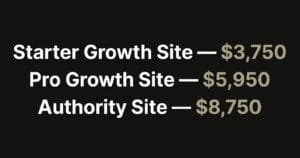
A sensible package structure usually follows three levels.
Starter: Establish Credibility Fast
A starter package fits a new business, solo operator, or company replacing an outdated one-page site. It should cover the essentials: a polished homepage, a few core pages, contact information, service summaries, a responsive layout, and clear calls to action.
This is often enough when your referrals are already strong and your immediate goal is to look legitimate when a prospect searches your name. The trade-off is depth. If you offer many distinct services or want to compete aggressively in local search, a small page count can limit how specifically the site speaks to each customer need.
Pro Growth: Build for More Search and More Leads
A growth-level package is usually the practical middle ground for established home service businesses. It allows room for individual service pages, stronger trust sections, more detailed copy, lead forms tailored to the business, and foundational on-page SEO across the site.
This level makes sense when jobs vary in value and customers use specific search terms. Someone looking for panel upgrades is not necessarily searching for a general electrician. Someone with a failed furnace wants reassurance that you handle repairs, serve their area, and can respond promptly. Dedicated pages give those visitors a better answer than a generic list of services.
Authority: Support a Larger Sales Footprint
An authority-level package is for businesses with a broader service catalog, multiple markets, an active content plan, or a serious need to outwork weaker competitors in search. It may include more service pages, location-focused pages where they are genuinely useful, advanced lead-routing options, deeper SEO planning, and training for the team that will manage updates after launch.
More pages are not automatically better. Thin city pages copied and pasted with a different town name will not build trust. The value comes from giving each important customer segment a useful, specific page. Choose this level when there is a real business case for that depth, not because a bigger package sounds more impressive.
Compare Outcomes, Not Just Page Counts
Page count is easy to compare, which is why many providers lead with it. It is not the whole story. Two five-page websites can produce very different results depending on the message, page hierarchy, mobile experience, and way they handle a lead.
When comparing proposals, look at what happens after someone lands on the site. Can they call with one tap? Is the main offer obvious without scrolling through a mission statement? Does the contact form ask for enough information to qualify the lead without feeling like paperwork? Are testimonials placed near the decision points, rather than hidden on a separate page few people visit?
Also ask who handles the words. Many business owners can explain their work clearly in a conversation, but turning that knowledge into concise web copy is another task. A package that includes guided copy development can save time and prevent the familiar cycle of a nearly finished website waiting months for content.
Watch for the Cheap Package Trap
Low entry pricing is not always a problem. A simple site should cost less than a larger one. The problem is a package that appears inexpensive because it excludes the work you assumed was included.
Before you commit, get direct answers on these points:
- Is custom copy included, edited, or entirely your responsibility?
- Are domain, hosting, and any third-party software costs separate?
- Does the price include mobile optimization, basic SEO setup, and form testing?
- Who supplies photos, and is there a plan if your current photos are not usable?
- What happens after launch if you need an update, fix, or additional page?
You do not need every possible feature at launch. In fact, adding too much too early can slow down a project that should be getting your business online. But you do need a package that is honest about what it delivers. A site that launches quickly but has no usable calls to action, weak copy, or broken forms is not a fast win. It is unfinished work with a live URL.
A Fast Launch Requires Decisions From Both Sides
A fixed delivery timeline is valuable, but it depends on a clean intake process. The builder needs your logo, service area, preferred contact details, examples of your best jobs, credentials, and honest answers about the customers you want. You do not need to become a marketer. You do need to make decisions when they are in front of you.
The strongest projects avoid unnecessary meeting overhead. A focused kickoff, organized questionnaire, clear review points, and prompt feedback will beat a calendar full of status calls. That is especially true for busy operators who are balancing jobs, crews, and customer calls while the site is being built.
For Omaha-area contractors and independent operators across the Midwest, this matters even more during busy seasons. Your website project should have a process that respects your time, gathers what is needed, and keeps moving without drama.
Plan for What Happens After Launch
Launching is the start of a working sales asset, not the end of the job. Once the site is live, pay attention to the basics: Are calls coming from the site? Are forms reaching the right inbox? Which service pages attract attention? Are customers asking questions that deserve clearer answers on the page?
Maintenance can be handled internally if someone has the time and confidence to make updates. It can also make sense to keep a support partner available for edits, security updates, content additions, and troubleshooting. Neither option is universally right. The key is deciding who owns the site after launch, rather than discovering months later that no one can update a phone number or add a new service.
The best package is not the one with the longest feature list. It is the one that gives your customers a clear reason to choose you, a simple way to contact you, and your business a dependable foundation to build on.