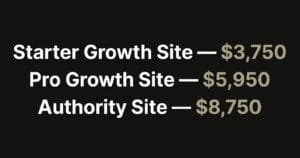
A website quote should not feel like a service call with no diagnosis, no parts list, and a blank check at the end. Yet that is how many small business owners experience the agency process: a vague estimate, a string of discovery meetings, and extra costs that appear once the work is underway. Fixed price web design takes a different route. You agree on the job, the cost, and the delivery path before the build begins.
For a plumber, HVAC contractor, electrician, restoration company, or independent professional, that clarity matters. You are not buying a website to collect design awards. You need a credible, mobile-first sales tool that helps people understand what you do, trust you, and contact you without hunting for a phone number.
What fixed price web design actually means
Fixed price web design is a packaged website build with a defined scope and a stated price. The package should spell out what is included: page count, content support, contact or booking features, basic search engine optimization, revision rounds, launch work, and delivery timing.
That does not mean every site looks the same. A proven framework can still be tailored to your services, service area, brand colors, proof points, photography, and ideal customer. The difference is that customization happens inside clear boundaries rather than through an open-ended hourly engagement.
A good fixed-price project answers practical questions early. How many pages are being built? Who provides photos and logos? Will the site include service-area pages, forms, review highlights, or online scheduling? What happens if you decide halfway through that you also need a resource library or 20 additional location pages? Clear answers prevent friction on both sides.
Why clear scope is good for your business
The biggest advantage is not simply knowing the number on the invoice. It is knowing what has to happen between kickoff and launch.
Traditional agency projects often bill by the hour or begin with a broad estimate. That model can work for complex organizations with shifting requirements, multiple stakeholders, and custom software needs. For a busy local operator who needs a five-to-ten-page lead-generation site, it can create unnecessary drag. Every decision becomes a meeting. Every revision becomes a budget question. The launch date slips while the business keeps sending prospects to an outdated site.
A fixed build creates accountability. The designer has an incentive to run an efficient process. The client has a straightforward checklist for providing the information needed to move forward. Both sides can focus on the work that matters: clear messaging, persuasive service pages, strong calls to action, and a site that works properly on a phone.
There is another benefit that gets overlooked: easier planning. When you know the cost and timeline, you can coordinate a rebrand, new service launch, seasonal push, or marketing campaign around a real date instead of a hopeful estimate.
The scope should be specific, not suspiciously simple
Not all fixed-price offers are equal. A low number is not a bargain if it buys a generic template, thin copy, slow communication, and no thought about how visitors become leads.
Before choosing a package, look for detail in the deliverables. A useful scope explains the number and type of pages, such as Home, Services, About, Reviews, Contact, and individual high-value service pages. It should clarify whether copy is written or refined, whether basic on-page SEO is included, and whether the site will be set up with conversion essentials such as click-to-call buttons and form notifications.
It should also explain the process. You should know when you will provide inputs, when you will review the draft, how many revision rounds are included, and what the expected turnaround is after feedback is received. “Unlimited revisions” may sound generous, but it usually signals a project without a finish line. Defined revisions encourage useful decisions and keep momentum.
For service businesses, the details that deserve attention are rarely flashy. They are the practical items: prominent phone numbers, service coverage, trust signals, license or insurance information where relevant, reviews, before-and-after work, response expectations, and a contact path that is easy to use with one hand.
What is usually outside the package
A fixed price only works when additions are handled plainly. Major changes after approval, extra pages, advanced integrations, custom calculators, e-commerce, extensive photography, or large-scale SEO campaigns may fall outside the original scope. That is not a gotcha. It is normal project discipline.
The right provider will flag those items early and quote them separately before doing the work. No surprises. No vague “we will see” language. If your needs change, the scope and price should change with them.
Fixed price versus hourly web design
Hourly billing is not inherently bad. It is often the better fit when the work is exploratory or genuinely unpredictable. A business building a custom customer portal, connecting several internal systems, or managing a large content migration may need the flexibility of time-and-materials work.
For most small business website projects, however, the core requirements are knowable. You need a professional structure, clear positioning, pages for your services, local relevance, proof that you are legitimate, and easy ways to call or submit a request. Those needs can be packaged without cutting corners.
The trade-off is straightforward. Fixed pricing gives you cost certainty and a clearer launch path, but it requires decisions. You need to choose a package that fits your current goals, provide inputs on time, and resist turning a focused build into a never-ending wish list. In return, you get a project built to finish.
Hourly work gives more freedom to change direction, but that freedom can cost more and take longer. Neither model is automatically better. The right one depends on whether you need a defined marketing website or an evolving custom product.
How a fixed-price website should generate leads
A fixed scope should never mean a fixed, cookie-cutter strategy. The best projects use a repeatable process because the fundamentals of conversion are repeatable, then adapt the site to the business.
Start with the visitor’s first question: “Am I in the right place?” Your homepage should quickly state the service, the market or service area when useful, and the next action. A homeowner with a leaking water heater is not looking for a brand manifesto. They are looking for an experienced professional, proof that you handle the job, and a fast way to reach you.
Service pages should do more than name a service. They should explain the problem, the work you perform, who it is for, and why a customer should call your company. Strong pages also address common concerns, such as turnaround time, service coverage, financing, warranties, or what to expect during the job.
Then make conversion easy. Phone calls, short forms, booking links, and visible calls to action should appear where a ready-to-act visitor needs them. The site should load quickly and read cleanly on mobile because that is where many local service searches happen. If the page is slow, the number is buried, or the form feels like paperwork, leads leak out.
Questions to ask before you sign
Ask for the full scope in writing and read it like you would any other business agreement. Confirm the page count, content responsibilities, timeline, platform, mobile design, search fundamentals, revisions, and launch support. Ask who owns the website and its assets when the project is complete.
Also ask how the provider handles delays. A disciplined process should account for the reality that owners are busy. It should not punish you for needing a day to answer a question, but it should set expectations so a two-week build does not become a four-month stall.
Finally, ask what happens after launch. Some businesses want to make their own small edits after training. Others want a partner for maintenance, new pages, seasonal campaigns, and ongoing improvements. Both are reasonable, as long as the options and costs are clear.
A website project should have a finish line
Fixed price web design is not about making a website cheap. It is about making the investment understandable and the process manageable. For a business that needs more calls, form submissions, and booked jobs, a clear package can remove the agency theater and keep attention on results.
Browncoat Digital builds around that discipline: defined packages, senior-led guidance, and websites designed to get a busy operator to launch without the drama. Pick the scope that matches the business you have now, leave room for smart additions later, and get a site working for you while your competitors are still stuck in meetings.