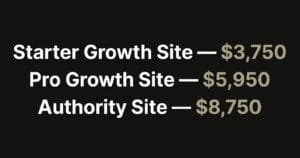
A website project can go sideways before the first page is designed. You ask an agency for a quote, get a broad range, sit through several discovery calls, and still do not know when the site will launch or what the final bill will be. The agency vs packaged website design decision usually comes down to one practical question: do you need a fully custom engagement, or do you need a proven lead-generation website built on a clear schedule?
For most service businesses, the answer is not about chasing the most creative option. It is about getting a credible, mobile-first site live quickly, making it easy for customers to call or request service, and knowing exactly what the project requires from both sides.
Agency vs packaged website design: the real difference
A traditional agency is built to handle a wide range of client needs. That can include brand strategy, market research, custom design systems, complex development, campaign planning, content production, and ongoing marketing. The upside is flexibility. The trade-off is that every decision may need to be scoped, approved, scheduled, and billed.
Packaged website design takes a different route. It starts with a defined framework: a known number of pages, a clear set of lead-generation features, an established process, and a fixed delivery window. The site is still tailored to your business, services, brand, and local market. What is not reinvented is the project management machinery behind it.
That distinction matters when you are running jobs, managing a crew, returning customer calls, and trying to keep the business moving. A website should not become a second full-time job.
When a packaged website is the better fit
A packaged build works best when your business has a straightforward goal: explain what you do, show why customers should trust you, and give them a fast path to contact you. That covers a large share of local service companies, from HVAC and electrical contractors to landscapers, restoration firms, plumbers, and independent professionals.
These businesses usually need a site with a strong home page, service pages, service-area information where relevant, trust signals, clear calls to action, contact forms, click-to-call buttons, and a foundation for local search visibility. None of that requires an open-ended strategy engagement. It requires good judgment and disciplined execution.
The biggest advantages are speed and certainty. You know the price range before the project begins. You know what is included. You have a defined intake process instead of an endless series of meetings. And you can plan around a real launch timeline rather than a vague promise that the site is “in progress.”
A package also creates useful guardrails. If your team wants to add six new pages, a customer portal, custom animations, or a complicated quoting tool halfway through the project, that work can be evaluated separately instead of quietly stretching the timeline and budget. No surprises. No hassle. Just a clear decision.
Packages are not template sites
A common concern is that packaged means generic. It should not. A good package uses a repeatable conversion framework, not recycled copy and a logo swap.
Your site still needs to reflect your services, customers, differentiators, reviews, service territory, photos, and brand personality. A restoration company should not sound like a tax consultant, and a premium home services business should not look like a discount directory listing. The structure can be proven while the content and presentation remain specific to the business.
Think of it like a well-run field operation. The process is established because it works. The work itself is adjusted to the job.
When an agency may be worth the extra time and cost
There are cases where a traditional agency is the right call. If you are launching a new brand with no positioning, need extensive customer research, operate across multiple markets, sell a complex product, or need custom software tied into the website, a package may be too narrow.
An agency can also make sense when the website is part of a larger marketing overhaul. Maybe you need a new brand identity, paid media strategy, photography direction, email automation, printed collateral, and ongoing campaign management. Coordinating all of that through one larger partner can be valuable.
The question is whether those services are genuinely necessary now. Many small businesses are paying for agency overhead when their immediate problem is simpler: their current website is outdated, hard to use on a phone, unclear about services, and failing to turn visitors into calls.
Do not buy a full-scale agency engagement because it sounds more official. Buy the level of service that matches the business problem.
Compare the parts that affect your bottom line
Price is the obvious comparison, but it is not the only one. A lower initial quote can become expensive if the project drags on for months, requires constant input from you, or launches without the pages and calls to action needed to produce leads.
With an agency, pricing often reflects time and scope. That is reasonable for custom work, but it can make the final cost harder to predict. A packaged build typically uses fixed pricing for defined deliverables, with clear pricing for anything beyond the package. For a busy owner, that makes budgeting easier.
Speed is another major factor. Agencies often have more layers: account management, creative review, development queues, and multiple approval rounds. Those processes can improve a large, complex project. For a five-to-ten-page service website, they can also create delay without adding much business value.
Flexibility favors agencies, at least on paper. They are designed to accommodate unusual requirements. But flexibility has a cost when every change opens a new conversation. Packages offer enough room to tailor the site while keeping the build moving. If your needs are mostly standard, that limitation is often a benefit.
Lead generation should be the deciding measure. A polished site that leaves visitors wondering what to do next is not doing its job. Whether you choose an agency or a package, look for practical conversion work: prominent phone numbers, clear service descriptions, focused page structure, trust-building proof, fast mobile performance, and forms that do not ask for a life story.
Ask what happens after launch
A website launch is not the finish line. Your phone number may change. You may add services, hire new staff, collect better photos, or want to publish new reviews. Before hiring anyone, ask how updates work after the site goes live.
Some agencies provide ongoing support but require a monthly retainer or bill updates at an hourly rate. Some packaged providers include training so you can handle basic changes, then offer maintenance when you would rather keep it off your plate. Neither model is automatically better. The right choice depends on how often the site will change and who on your team can own the work.
Also ask about ownership. You should understand who owns the domain, website content, design assets, and hosting account. Clear answers here are a sign of a partner with its house in order.
A simple way to choose
You are likely a strong fit for packaged website design if you can clearly describe your services, know the customers you want, and need a professional site without a long planning phase. You may need an agency if the project depends on deep research, custom functionality, or a broad brand and marketing transformation.
Before you sign anything, get direct answers to four questions:
- What pages, features, and revisions are included in the quoted price?
- What do you need from me, and when, to keep the project on schedule?
- What happens if I need work outside the original scope?
- How will this site turn a mobile visitor into a call, form submission, or booked job?
The best website partner is not the one with the most meetings or the fanciest pitch deck. It is the one that can show you a clear path from your current site problem to a finished website that helps your business earn trust and generate work. Pick the process that lets you get there without the drama.